Smart Tank vs LaserJet Printer: In-Depth Comparison
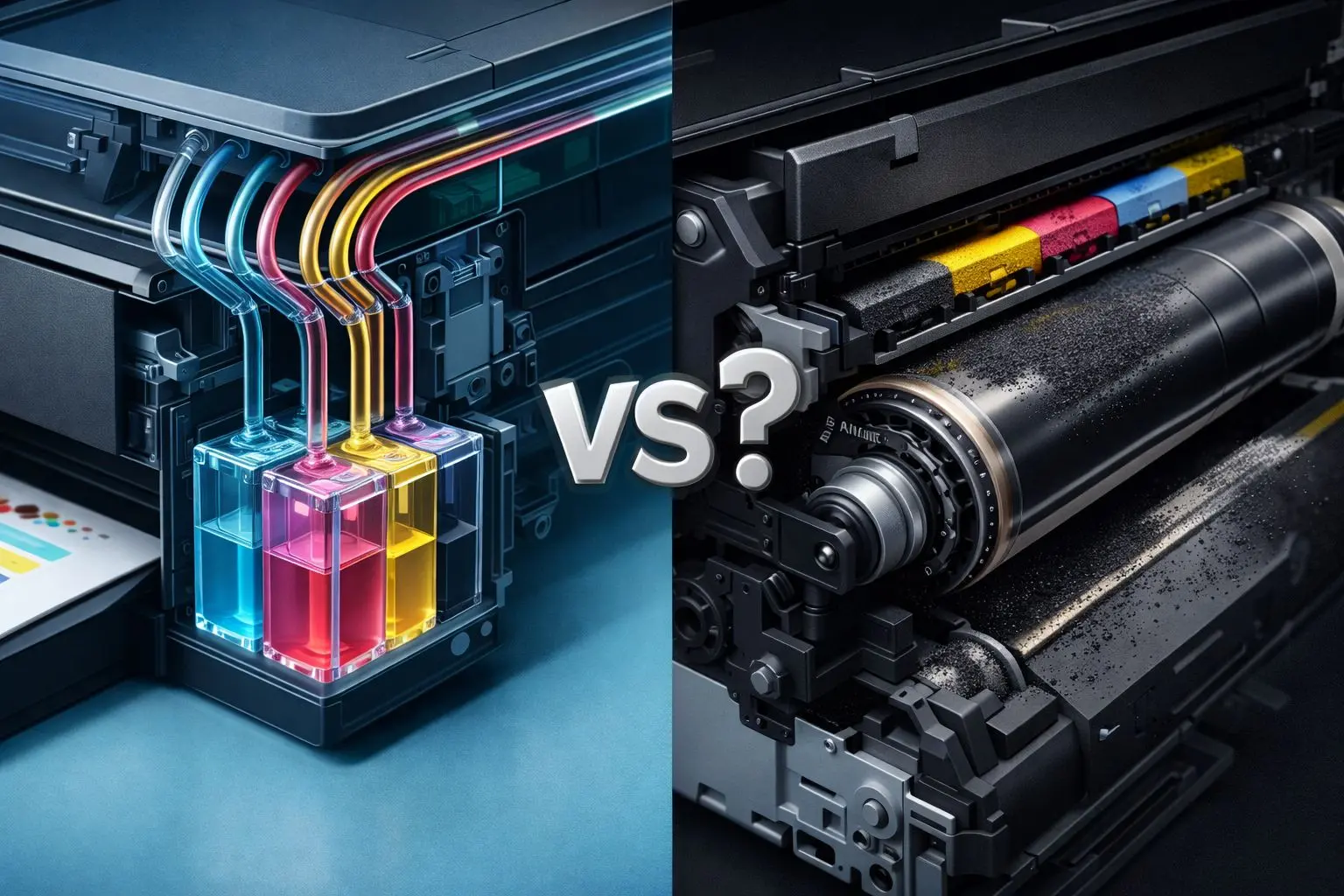
In the rapidly changing landscape of printing technology, making the right decision between a Smart Tank (ink-tank) printer and a LaserJet printer can make a huge difference on your pocket and working routine. While HP Smart Tank printers are famous for their refillable ink tanks, offer low printing costs, LaserJet printers are the fastest and more reliable option. In this Smart Tank vs LaserJet printer comparison, we will explore the technical specifications, prices and uses of these two types of printers. As the need for budget-friendly printing solutions has increased with the growing trend of working from home and small businesses, it is essential to consider the cost per page and total cost of ownership.
How Smart Tank (Ink-Tank) Printer Work
Smart Tank printers, such as the HP Smart Tank 500 and HP 700 series, use a continuous ink supply system with big, refillable reservoirs rather than regular cartridges. This ink reservoir system contains up to 100ml of ink per color, allowing you to print thousands of pages before needing to refill.
The printhead technology uses piezoelectric or thermal devices to release microscopic ink droplets onto paper, resulting in exact images. Refilling is simple: users pour ink from bottles into color-coded tanks using spill-free nozzles, which reduces mess and waste.
Page yield is impressive, a single black ink bottle can print up to 6,000-8,000 pages, while color yields can reach 7,000 pages. Maintenance cycles are straightforward, with only occasional head cleaning to prevent clogs and less frequent than cartridge-based inkjets.
How LaserJet Printers Work
LaserJet printers, such as the HP LaserJet M136w or M139fnw, rely on electrophotographic technology. A laser beam scans across a photosensitive drum unit, creating an electrostatic image that attracts toner powder. The toner cartridge system contains fine powder (toner) mixed with polymers, which is transferred to paper via the drum. A fuser assembly then uses heat and pressure to melt the toner, bonding it permanently to the page. This heat-based printing mechanism ensures smudge-proof outputs. The process starts with a warm-up phase, but modern models minimize it to seconds.
Toner systems cost more long term because cartridges yield 1,000-3,000 pages but are pricier to replace. Often 10,000+ PKR each in Pakistan. While efficient for monochrome, color toners add expense, pushing total ownership higher for mixed-use scenarios.
Core Component Comparison
This side-by-side table illustrates the differences between the Smart Tank and LaserJet printers:
Smart Tank (Ink-Tank) | LaserJet | |
Printing Technology | Inkjet with refillable tanks | Electro-photographic with laser |
Consumables | Ink bottles (e.g., HP GT series) | Toner cartridges (e.g., HP 85A/107A) |
Speed | 10-15 ppm black, 5-9 ppm color | 20-30 ppm black, 15-21 ppm color |
Warm-up Time | Instant | 10-30 seconds |
Maintenance Parts | Printhead (Replaceable in Case of Fault | Drum unit, fuser (every 20k-100k pages |
Energy Consumption | 3-5W idle, 10-15W printing | 5-10W idle, 300-500W printing |
Typical Lifespan | 3-5 years with moderate use | 5-7 years, robust for heavy duty |
Best For | Color graphics, home/small business, Photo's | Text documents, offices |
Benefits and Drawbacks of Smart Tank Printers
Pros:
- incredibly cheap per page, especially for color
- Simple refills with little waste.
- Compact designs work well in homes.
- Great for graphics and pictures.
Cons:
- reduced print speeds.
- ink may dry out if left unused.
Benefits and Drawbacks of LaserJet Printers
Pros:
- Fast first-page output and printing.
- Excellent text quality for business documents.
- Toner doesn't dry out, so it requires little care.
- Effective for frequent/bulk use.
Cons:
Higher upfront and consumable costs.
Bulkier and power-hungry.
- Printing quality and printer health will be compromised if non-original toner (counterfeit/refilled) is used.
Cost Comparison: Ink Tank vs Laser Printer
Here are some Entry-level and Mid-range printers in both Smart Tank and LaserJet series
Entry-level Smart Tank: HP Smart Tank 585 All-in-One.
Mid-range Smart Tank: HP 750 Smart Ink Tank All-in-One with Duplex at.
Entry-level LaserJet: HP LaserJet M136w Multifunction, HP LaserJet M211dw.
Mid-range LaserJet: HP LaserJet M139fnw Pro MFP
Upfront costs in Pakistan's market:
Ink bottle vs toner cartridge cost favors ink tanks. HP ink bottles yield high pages at low replacement cost vs. LaserJet toners.
Cost per page breakdown: Smart Tank at 0.10–0.60 PKR black/0.50–2 PKR color; LaserJet at 15–20 PKR black/40-50 PKR color.
Ink tank printers are generally cheaper for color printing because bottles provide higher yields at lower prices, reducing inkjet vs laser printer cost gaps significantly.
Home Use vs Office Use
For home users, including students printing assignments or families handling photos, inkjet vs laser printer for home use tilts toward Smart Tank, as they provide cheap, versatile printing without frequent toner swaps.
The best printer for a large office; where high speed and large print volume is required, is often a LaserJet, for its speed in handling reports and invoices.
LaserJet is better when volume exceeds 1,000 pages monthly or text dominates. Smart Tank excels for mixed color/text at lower volumes. In small business/home office, hybrid needs favor Smart Tank for cost savings.
Print Quality Comparison
Text detail is a strong point for the LaserJet, with sharp, professional-looking edges that are great for documents. Graphics are good but not as colorful as the Smart Tank's ink-based printing.
Photo print quality is a strong point for the Smart Tank, with smoother gradients and more vivid colors on glossy/matt Paper. Paper compatibility is an advantage for the Smart Tank, which can print on envelopes and photo paper, while the LaserJet is best suited for standard office paper that won't curl specialty papers.
Environmental & Energy Factors
Energy consumption varies: Smart Tank consumes 10-15W, whereas LaserJet consumes 300-500W because of heating components.
The disposal of cartridges is higher in LaserJet because of plastic toners, thus increasing landfill problems. Smart Tank's refill process is more environmentally sustainable, reducing packaging by 90% and encouraging eco-friendliness.
Final Verdict and Buying Recommendations
The decision between Smart Tank and LaserJet printers is based on your specific requirements. For budget consumers with low-to-medium volume (under 1,000 pages/month) and color-heavy printing, Smart Tank is the most affordable printer for better quality color printing while providing a lower total cost of ownership.
Despite the extra expense, high-volume, text-focused consumers should opt for a LaserJet for speed and durability, which is ideal in large offices or organizations.
Frequently Asked Questions
Which is cheaper? Smart Tank printers generally have lower total cost of ownership for color printing due to inexpensive ink refills, ideal for budget-conscious users.
Which is faster? LaserJet printers outperform with quicker print speeds and minimal warm-up time, suiting high-volume tasks.
Which is better for home? Smart Tank shines for occasional color prints like photos or schoolwork, offering cheap ink tank printer advantages.
Which is better for office? LaserJet is the best printer for office use, handling text-heavy documents efficiently without frequent maintenance.
Print quality edge? LaserJet for sharp text; Smart Tank for vibrant graphics.
Energy efficiency? Smart Tank consumes less power during idle modes.
Longevity? LaserJet typically lasts longer in demanding environments.


Comments (0)